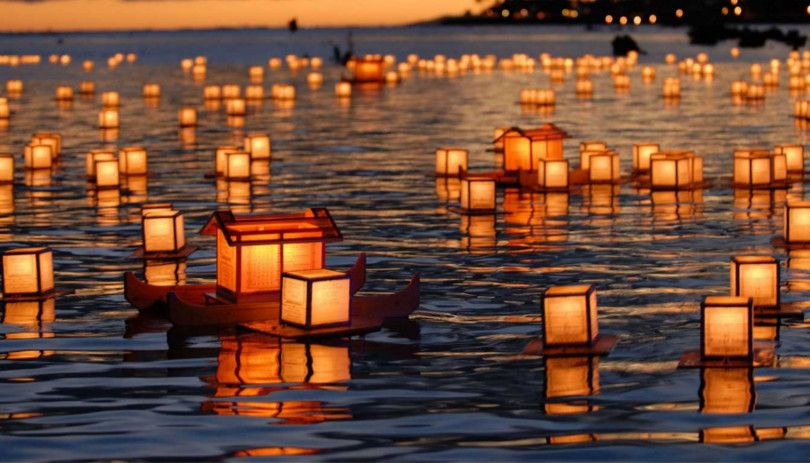
Obon festivals celebrate a time-honored Japanese Buddhist tradition—a call to reflect on all those who came before us and consider what they gave to our world so we could be here today.
In Japan, Obon is marked by a mid-August holiday, when many people return to their hometowns to visit family, clean gravesites, and make offerings. It is believed that, during this time, ancestral spirits temporarily make their way back to this world.
For Japanese Americans, Obon evolved into a multicultural celebration centered on food, cultural demonstrations, and bon odori or folk dancing. Held at local Buddhist temples, the events were a time for community and gathering.
Even though Obon is rooted in Buddhist traditions, the core meaning of obon—remembering and honoring spiritual ancestors—transcends religion.
Last year, I wrote a story about a unique Obon festival that was celebrated at one of Los Angeles’ historic Japanese American Christian churches: From Obon to Pride: Evergreen Baptist Church of Los Angeles Celebrates 100 Years. The church has a fascinating history that encompasses the Japanese American experience in Southern California, so I was honored to be able to write about their 100-year anniversary for Discover Nikkei.
Below is the story.
From Obon to Pride: Evergreen Baptist Church of Los Angeles Celebrates 100 Years
At Evergreen Baptist Church of Los Angeles’ Obon Remembrance service in late July, congregants solemnly wound their way toward a large three-tiered structure illuminated by candles. Under a simple wooden cross, each person lit a tea candle and placed photographs or cloud-shaped cards in the lower two tiers—filling this Christian obutsudan or altar of remembrance with memories of their spiritual ancestors.
At first glance, Buddhist traditions such as celebrating Obon and giving offerings at an obutsudan seem out of place at a Christian church, even a historically Japanese one. But Jason Ashimoto, senior pastor of Evergreen Baptist Church of Los Angeles, believes that the meaning behind these traditions—remembering and honoring spiritual ancestors—is universal and transcends religion.
“I thought, why don’t Christian churches have this, especially Asian American churches, where ancestors are such an important part of our culture and values,” said Ashimoto during the Obon Remembrance service. “I wanted to do something for us, for our centennial, and to remember the faith of those who had gone before us and impacted us here at Evergreen.”
This year, Evergreen Baptist Church of Los Angeles—one of the early Christian institutions founded to serve the Los Angeles Japanese community—is commemorating its 100th year. Guided by the theme of Sacred Celebrations, the church is hosting events, seminars, and exhibitions that honor its Japanese American history while embracing its multi-ethnic and inclusive future.
Celebrating Obon
“The idea for our Obon stemmed from remembrance and a way to help bring our congregation of the last 100 years into our celebration,” said Ashimoto. “So we took the respectful liberty of christening Obon into something where our church can engage and find meaning.”
Evergreen Baptist Church of Los Angeles’ first ever Obon festival spanned two weekends. The first weekend featured a remembrance service and offerings to the Christian obutsudan. The second weekend was about fun and community, with water activities, uchiwa fan making, and a food fair with spam musubi, char siu bao, egg rolls, and Korean fried chicken—choices that reflected the church’s pan-Asian congregation.
The festival was so successful that Ashimoto said it might become an annual event. He shared that members have already come up with ideas for future Obon festivals, including favorite foods and dance lessons for a bon odori.
The response was particularly meaningful given the congregation’s diversity, many of whom had not participated in an Obon celebration before.
“Our community was engaged, especially for the obutsudan and bringing photos for it, praying, and lighting candles,” said Ashimoto. “It gave everyone a chance to remember their loved ones as part of the celebration.”
Roots in the Boyle Heights Neighborhood
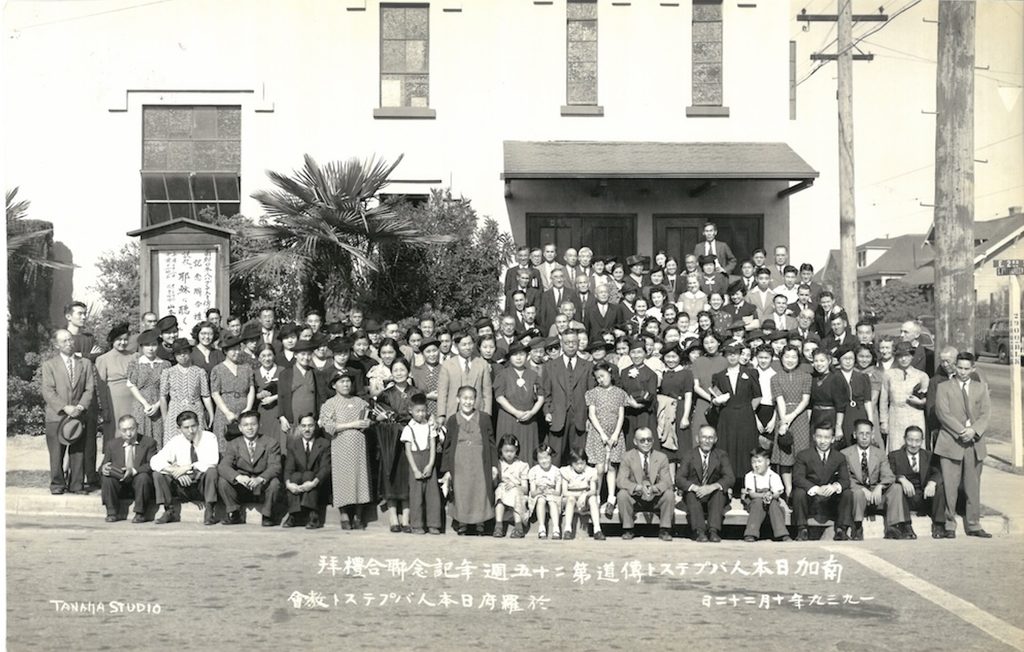
Photo courtesy of Evergreen Baptist Church of Los Angeles
Caption: Reverend Haruye Shibata, the first pastor of the Los Angeles Japanese Baptist Church (which eventually became Evergreen Baptist Church of Los Angeles), poses with his congregation in 1939. The photograph was taken in front of the original church built in 1926 on the corner of East 2nd Street and South Evergreen Avenue.
In the early 1900s, the Japanese immigrant community in southern California was growing. In 1910, there were approximately 8,400 Japanese in Los Angeles County; by 1930, the population had quadrupled to more than 35,000. The Los Angeles Baptist City Mission Society responded by setting up mission stations in three Los Angeles area communities with high concentrations of Issei or first-generation Japanese Americans: Moneta (a neighborhood of Gardena) in 1914, Terminal Island in 1917, and Boyle Heights in 1925.
Reverend E.H. Jones, a retired Baptist missionary who had spent 35 years in Japan, and Reverend Minosuke Ito, the pastor at Terminal Island, founded the Boyle Heights mission station in 1925. Within a year, a church building was erected on the corner of East 2nd Street and South Evergreen Avenue and Reverend Haruye Shibata was named as its first pastor. Known as the Los Angeles Japanese Baptist Church, the congregation expanded as families in the surrounding area participated in programs such as a Sunday school, a Japanese language school, and boys’ and girls’ clubs.
As more Nisei or second-generation Japanese American members joined, the church hired its first English-speaking minister, Reverend Jitsuo Morikawa, in 1940. During this time, Morikawa became a friend and mentor to a church youth worker named Paul Nagano, who would later become instrumental in reestablishing the Los Angeles Japanese Baptist Church after World War II.
Incarceration and Rebuilding
Following Japan’s attack on Pearl Harbor on December 7, 1941 and the subsequent declaration of war, US President Franklin Delano Roosevelt signed Executive Order 9066 in February 1942. This act led to the forced removal and incarceration of more than 120,000 people of Japanese ancestry, nearly 70,000 of whom were American citizens. The Los Angeles Japanese Baptist Church was forced to close and the building was used by the US government as a civilian control station—a place for Japanese households to register and report for evacuation to the concentration camps.
Morikawa, Nagano, and many of the church’s congregation were sent to the Poston Relocation Center, a group of three camps built on the Colorado River Indian Reservation in Arizona. More than 17,000 people of Japanese ancestry were incarcerated there. At Poston, Morikawa and Nagano worked together with other Christian leaders from different denominations to form the interdenominational Poston Christian Church, which conducted services in Japanese and English. They set up rotational schedules called “The Circuit”, where pastors traveled between the three Poston camps, the Manzanar camp in California, and the Gila River camp in Arizona to conduct worship services in English and Japanese.
After the war, Nagano returned to Los Angeles to help resettle and rebuild Japanese Baptist congregations in southern California, including the Los Angeles Japanese Baptist Church. To better serve the Japanese who returned to the Boyle Heights neighborhood, the church divided into two congregations: the Nisei Baptist Church for second-generation English-speaking members and the Japanese Baptist Church for Issei members. In 1949, the Nisei Baptist Church was renamed to Evergreen Baptist Church and, four years later, officially incorporated as Evergreen Baptist Church of Los Angeles.
Embracing a Multicultural Congregation
Evergreen Baptist Church of Los Angeles thrived during the immediate postwar years, but church membership declined in the 1960s and 1970s as social protests and unrest caused Japanese families to move away from the Boyle Heights area.
Under a new pastor named Cory Ishida, the church began attracting English-speaking Chinese Americans, and, in the early 1980s, hired its first Chinese American pastor, Ken Fong. Soon after, the church moved to its current location in Rosemead, a suburb of Los Angeles, to better serve its wider Asian American congregation. Attendance grew, so in 1996, the church divided into two congregations: Evergreen Baptist Church of Los Angeles in the original Rosemead location and Evergreen Baptist Church of the San Gabriel Valley.
Honoring the Past and Looking Faithfully Toward the Next 100 Years
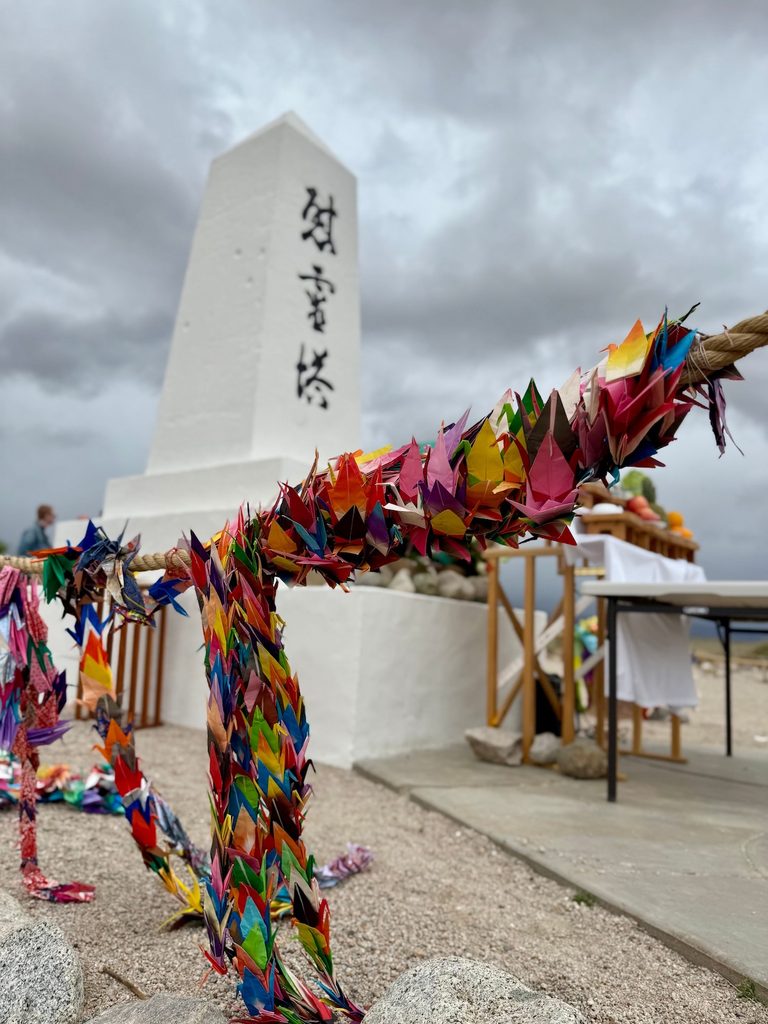
Photo courtesy of Fuller AACHI Substack
Manzanar’s iconic obelisk, inscribed with the kanji characters “ I Rei To” or Soul Consoling Tower, was designed by a Catholic master stonemason named Ryozo Kado and a Buddhist minister named Shinzo Nagatomi, who were both incarcerated at Manzanar during World War II.
Today, Evergreen Baptist Church of Los Angeles has adopted a broad mission to include a diverse community of Asian, non-Asian, and LGBTQ+ members. Its centennial events reflect this mission.
With roots as a historically Japanese Christian church, one of the most meaningful centennial events was a pilgrimage to the Manzanar concentration camp in April. Located about 225 miles north of Los Angeles, Manzanar was one of 10 concentration camps built in remote and desolate areas of the country to incarcerate people of Japanese ancestry from 1942 to 1945.
Organized in partnership with the Fuller Theological Seminary’s Asian American Center and the Little Tokyo Historical Society, more than 120 members and friends traveled together to participate in the Manzanar Committee’s 56th annual Manzanar Pilgrimage. The event, which drew more than 2,500 participants this year, began in 1969 as the first public event in the US to call attention to Japanese American incarceration during World War II.
“It was important that our church remember the resilience and faith of our spiritual ancestors who endured this historic act of injustice,” said Ashimoto. “Our pilgrimage highlighted how critical it is to remember these stories of injustice, teach that Jesus has always cared for the immigrant and the powerless, and to consider how churches can faithfully stand against such things.”
As it looks to the future, Evergreen Baptist Church of Los Angeles has been on a journey to become a more open and inclusive church, including for LGBTQ+ Christians. Years of discussions and intentional learning by church members and leaders have led to the start of an LGBTQ+ fellowship, affirmation of membership, service in the church, and an allowance for pastors to officiate weddings if they feel a conviction to do so.
For Pride Month in June, the church unveiled a special centennial exhibition titled, “Imagining a Queer Heritage”, which explores the impact of the queer experience on the church’s history. The exhibition invites visitors to “hold space for the stories of Evergreen’s beloved queer community today as well as those unidentified and unnamed, that have paved the way for our celebration during this centennial year.”
Later in the year, events to honor its Chinese American heritage include a trip to the Chinese American Museum and a Chinatown tour and seminar on the history of Chinese American Christianity.
“We want to make the whole year a celebration,” said Ashimoto. “We have evolved from a historical Japanese American church to a pan-Asian one. In the next 100 years, it is important to embed our collective stories and experiences as a core narrative within the church. We can’t lose them, as they are the backbone of our church and remind us of who we are.”
Other Stories for Discover Nikkei
A New Book Teaches Kids About JA History