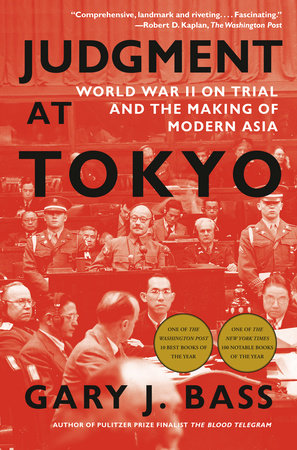
“Judgment at Tokyo: World War II and the Making of Modern Asia” by Gary J. Bass was an eye-opening read. As a writer, I spend a lot of time reading, researching, and learning new things. It is one of the aspects of being a writer that I absolutely love. I picked up this book as background research for my current writing project.
Published in October 2024, the hefty 900-page book paints a comprehensive portrait of the Tokyo War Crimes Trial, which was conducted from 1946 to 1948 and was modeled on the Nuremberg Trials.
Judgment at Tokyo vs the Nuremberg Trials
The Tokyo Trial is far less known than the Nuremberg Trials, despite the fact that both proceedings were international tribunals. They brought to light the crimes and atrocities committed during World War II, led to the prosecution of war criminals, and expanded international criminal law. But there were some differences:
- Three defendants were acquitted at Nuremberg but none were acquitted at Tokyo. Of the 24 high-level Nazi leaders indicted for conspiracy, war crimes, crimes against peace, and crimes against humanity, 19 were found guilty and sentenced. Punishments ranged from death by hanging to imprisonment. Three prisoners were acquitted, one committed suicide in prison, and one was found to be mentally unfit to stand trial. In contrast, of the 26 high-level military and civil Japanese leaders indicted at the Tokyo Trial, all were found guilty and sentenced to death or imprisonment. Two prisoners died during the trial and one suffered a mental breakdown.
- Media coverage of the Tokyo Trial was restricted by the US occupation forces. Nazi atrocities presented at Nuremberg were well documented and reported by international media; however, at the Tokyo Trial, the US occupation forces under General Douglas MacArthur restricted media coverage, thereby limiting and skewing the information that came out of the proceedings.
- A broader group of judges representing additional allied forces and territories that had been occupied by Japan were included in the Tokyo Trial. There were four judges at Nuremberg representing the allied forces: US, Great Britain, France, and the Soviet Union. At the Tokyo Trial, there were 11 judges, including the allied forces represented at Nuremberg (US, Great Britain, France, and the Soviet Union), additional allied forces (Australia, Canada, New Zealand, and the Netherlands), and territories that had been occupied by Japan (China, Philippines, India).
- Colonialism, racism, and conflicting views of the Japanese emperor’s role in the war made the judgments from the Tokyo Trial more controversial than those made at Nuremberg.
Judgment at Tokyo Highlights Victor’s Justice
Before reading Judgment at Tokyo, I didn’t know a lot about the Tokyo Trial and the controversies surrounding it.
The trial brought to light the atrocities committed by the Japanese army against other Asians and POWs during World War II. But there’s a broader context for consideration — the idea of victor’s justice. Were those atrocities any worse than the firebombing of Japanese cities and the use of two atomic bombs by the victorious Allies or the decades-long oppression of Asians by western colonial powers?
There were three dissenting judges (India, France, and the Netherlands), with the judge from India, Radhabinod Pal, penning the strongest and most complete dissent. He questioned the legitimacy of the trial, citing “victor’s justice” and the lack of consideration of Allied actions, particularly the use of the atomic bombs, during the war. Of the three Asian judges (India, the Philippines, and China), he was the only one to write a dissent. He was also the only one to have not been directly attacked by the Japanese during the war (the Chinese judge experienced the bombing of Chongqing and the Philippine judge was a soldier in the US army on Bataan).
Asia for the Asiatics
Indeed, the racial component cannot be dismissed and Judgment at Tokyo does well to bring this to light.
Great Britain, the US, France, and the Netherlands were colonial powers that had spent decades in Asia, oppressing the people and exploiting the resources. During the trial, the defendants justified Japan’s advances as a way to counter western imperialism and racism by promoting the idea of “Asia for the Asiatics”. While the Japanese were initially welcomed in these countries, their actions turned out to be just as exploitative as the western imperialists.
After the war, as the Allies tried to reestablish their colonies in Asia, countries such as India, Indonesia, and Vietnam fought for independence rather than returning to colonial rule.
Protecting Emperor Hirohito
Unlike at Nuremberg, the US had an outsize role at the Tokyo Trial. Japan’s postwar occupation was led by US General Douglas MacArthur, who exerted significant influence on the trial. The main beneficiary of this influence was Emperor Hirohito, who was viewed as useful in keeping the peace and implementing societal reforms during the postwar occupation and, even as a figurehead, an integral part of Japan’s future. Despite the objections of the other Allies and evidence to suggest otherwise, the US protected the emperor from being charged as a war criminal.
Politics in Postwar Japan
The Tokyo Trial was supposed to be the first of a series of war crimes trials held in Japan. However, by the late 1940s, the threat of Communism and the rise of the Cold War reshaped the political landscape of postwar Japan. The US became more concerned about shoring up Japan as a key anti-Communist ally in the region, so the day after the top convicted criminals from the Tokyo Trial were hanged, most of the other accused war criminals who were awaiting trial in Sugamo prison were released.
According to Judgment at Tokyo, many of these men went on to hold leadership positions in government and business, and were instrumental in Japan’s economic rise. They also contributed to the rise of Japan’s Liberal Democratic Party (LDP), which has dominated postwar Japanese politics since its founding in 1955, and is known as a conservative, anti-Communist, and nationalistic political party. Interestingly, it appears that the US Central Intelligence Agency (CIA) helped the LDP gain power in the 1950a through financial support.
One of the most notorious was Kishi Nobusuke, who had been a cabinet member during the war and was considered a Class A war criminal. As a result of his release, Kishi was able to regain positions of power, becoming Prime Minister in 1957. He called the Tokyo Trial “a farce” and used his political platform to promote his conservative and anti-Communist views. I was surprised to learn that he was the grandfather of Shinzo Abe, who was one of the most well known and longest-serving prime ministers in Japanese history.
Leave a Reply
You must be logged in to post a comment.